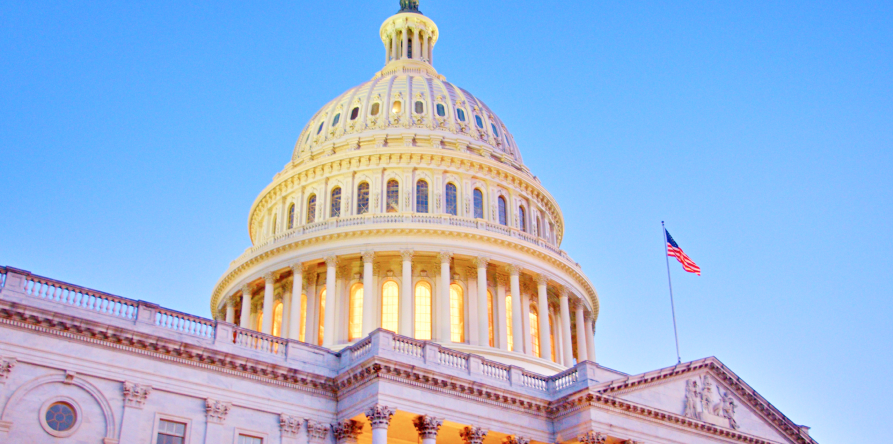
US midterm elections: What a Democratic sweep means for the economic outlook
The US midterm elections have delivered a resounding blue sweep, with Democrats taking control of both the House and Senate. While this is likely to constrain President Trump's domestic agenda, it could also increase the scope for fiscal easing. Our macro team examines the implications for US economic policy, AI investment and the wider global economy.
Originally published on November 4, 2026, by Fidelity International.
Written by Salman Ahmed, Global Head of Macro and Strategic Asset Allocation, and Ashray Ohri, Macro Strategist, Fidelity International.
Highlights
- Our secular return expectation for U.S. equities is below the long-term average due to lower growth potential and higher starting valuations.
- Our fixed income return expectations are near the long-term average, reflecting the broad alignment of starting bond yields with our secular views.
- As a result, we continue to expect U.S. stocks to outperform bonds, but by a smaller margin relative to history.
- We expect non-U.S. equity returns, especially in emerging markets, to exceed those of the U.S. while remaining lower than their respective long-term averages.
- Our capital market assumptions can help inform strategic asset allocation decisions by focusing on how economic and financial market inputs influence asset returns over long periods of time.
While final counting is still underway in some states, the results so far qualify as a historic Blue wave. According to the NYT nowcast, Democrats are looking to seal a 250+ victory in the House, which would be the largest House majority since 2008. The Senate victory has been equally decisive, with Democrats en route to gain eight seats to secure a 55-45 seat majority, the strongest since 2012. These commanding majorities in both chambers will give Democrats considerably more room to manoeuvre and set policy than the narrow congressional majorities of recent years.
However, while Democrats can set the agenda and write legislation, enacting major policy changes will remain difficult. The Senate filibuster and presidential veto will continue to constrain Democrats, even with control of both chambers. Instead, we expect Democrats to push spending priorities such as healthcare, other social spends and clean energy through reconciliation bills, which require only a simple majority. This becomes particularly relevant around fiscal deadlines, when Democrats can leverage negotiations with Republicans to secure concessions on their priorities.
There are two main sources of leverage for Democrats. The first is the debt ceiling, which could be reached around Q2 2027 under current spending plans, although extraordinary measures could push the ‘X date’ towards year-end. The second, and more immediate, is government funding, which expires on December 11. The deadline falls during the lame-duck session, with Republicans still controlling Congress, potentially prompting a final push to advance their spending priorities or constrain Democratic spending. However, limited agreement on full-year appropriations makes a short-term continuing resolution the most likely outcome, pushing the next funding deadline into early 2027 and keeping shutdown risks alive.
Overall, we see risks tilted towards greater fiscal easing as both parties potentially strike deals to advance their spending priorities. Despite a major fiscal boost with the One Big Beautiful Bill this year, we see limited inclination from either side of the political leadership to rein in the elevated fiscal deficit despite growth running strong.
Separately, Democratic control of the House would open the door to greater scrutiny of the Trump administration, including investigations into potential conflicts of interest around business dealings, prediction markets and possible impeachment proceedings. While removal from office would require a two-thirds Senate majority, such proceedings could consume political bandwidth and generate headline risks. A Democratic Senate could also block key appointments, including to the Fed, further constraining the President's domestic agenda.
Governor races to have important implications for the AI capex story
Beyond Washington, the gubernatorial races also carry important macro implications. Democrats flipped four governorships, of which three states - Texas, Ohio and Georgia – lie at the heart of the data centre build-out, accounting for almost a third of planned US data centre capacity. Democratic governors who campaigned on curbing data centre construction are likely to impose further moratoria and restrictions on new permits, alongside protections around water supplies, energy costs and investment incentives. These could have significant implications for AI-related infrastructure investment. For now, we see these risks as largely concentrated at the state rather than federal level. However, given the sensitivity of this issue among American voters, it could gain traction federally, particularly ahead of the 2028 elections. We see this as a key risk to our macro-outlook.
Executive powers remain largely intact
Outside the congressional shift in power, President Trump would retain considerable discretion over tariffs, immigration enforcement and foreign policy. With greater resistance to his domestic agenda, the administration could lean more heavily on executive powers and shift its focus externally. Accordingly, we continue to see upside risks to oil prices from the Iran war, while US trade policy is unlikely to change course materially. The administration is preparing Section 301 investigations into industrial overcapacity to replace tariffs struck down under IEEPA, suggesting trade restrictions will remain a central policy tool even under a Democratic Congress.
Implications for Rest of the World
With President Trump's executive authority largely unimpacted we expect little change in the current dealings of the US with the rest of the world when it comes to foreign policy agenda.
The key implications will continue to run through three main channels. The first is energy and we continue to expect upside risks in oil prices as escalation in the Iran war remains elevated. This is likely to remain a potential source of supply side shock to the global economy, weighing on inflationary pressures particularly in Europe and Asia that are major energy importers and also keep a bias towards monetary tightening.
The second is technology. The outlook for US AI investment and regulation will be particularly important for Taiwan and South Korea, given their central roles in the global AI supply chain, while semiconductor export controls will have more direct implications for China. These policies remain largely within the administration's executive remit, limiting the direct impact of the congressional shift.
Finally, trade tensions are likely to remain. On US-China trade relations we see little scope for a meaningful easing in tensions. Tariffs, technology restrictions and supply-chain diversification continue to enjoy broad bipartisan support, suggesting Democratic control of Congress is unlikely to materially change the direction of US policy towards China. The upcoming APEC summit could provide greater clarity on near-term trade negotiations, but the broader trajectory of US-China relations is unlikely to shift. Europe also remains affected by US agenda and developments on Ukraine although 2028 could mark the beginning of a period of normalisation if current trends continue.
Looking ahead
We see this historic blue wave constraining President Trump's domestic agenda and appointments, while leaving foreign policy largely unchanged under executive control. In our base case we expect US growth slowing down to trend next year after robust growth in 2026. This comes alongside a more challenging macro-environment with a renewed Fed hiking cycle, tightening financial conditions and building geopolitical and inflationary shocks.
We also see risks from the economy’s growing reliance on capex and the AI build-out which is shifting from the scale of capital expenditure to the returns that investment can ultimately generate. Tighter data centre regulation could slow the AI capex build-out and have important macro economic implications for the rest of the world.
Issued by Fidelity Investments Canada ULC (“FIC”). Unless otherwise stated, all views expressed are those of Fidelity International, which acts as a subadvisor in respect of certain FIC institutional investment products or mandates.
This material is for Institutional Investors and Investment Professionals only, and should not be distributed to the general public or be relied upon by private investors.
This document is provided for information purposes only and is intended only for the person or entity to which it is sent. It must not be reproduced or circulated to any other party without the prior permission of Fidelity.
This document does not constitute a distribution, an offer or solicitation to engage the investment management services of Fidelity, or an offer to buy or sell or the solicitation of any offer to buy or sell any securities in any jurisdiction or country where such distribution or offer is not authorized or would be contrary to local laws or regulations. Fidelity makes no representations that the contents are appropriate for use in all locations or that the transactions or services discussed are available or appropriate for sale or use in all jurisdictions or countries or by all investors or counterparties.
This communication is not directed at and must not be acted on by persons inside the U.S. and is otherwise only directed at persons residing in jurisdictions where the relevant funds are authorized for distribution or where no such authorization is required. Fidelity is not authorized to manage or distribute investment funds or products in, or to provide investment management or advisory services to persons resident in, mainland China. All persons and entities accessing the information do so on their own initiative and are responsible for compliance with applicable local laws and regulations and should consult their professional advisors.
Reference in this document to specific securities should not be interpreted as a recommendation to buy or sell these securities but is included for the purposes of illustration only. Investors should also note that the views expressed may no longer be current and may have already been acted upon by Fidelity. The research and analysis used in this documentation is gathered by Fidelity for its use as an investment manager and may have already been acted upon for its own purposes. This material was created by Fidelity International.
These materials may contain statements that are “forward-looking statements,” which are based on certain assumptions of future events. Forward-looking statements are based on information available on the date hereof, and Fidelity Investments Canada ULC (“FIC”) does not assume any duty to update any forward-looking statement. Actual events may differ from those assumed by FIC when developing forward-looking statements. There can be no assurance that forward-looking statements, including any projected returns, will materialize or that actual market conditions and/or performance results will not be materially different or worse than those presented. Past performance is not a reliable indicator of future results.
This document may contain materials from third parties which are supplied by companies that are not affiliated with any Fidelity entity (third-party content). Fidelity has not been involved in the preparation, adoption or editing of such third-party materials and does not explicitly or implicitly endorse or approve such content.
Fidelity International refers to the group of companies which form the global investment management organization that provides products and services in designated jurisdictions outside of North America. Fidelity, Fidelity International, the Fidelity International logo and F symbol are trademarks of FIL Limited. Fidelity only offers information on products and services and does not provide investment advice based on individual circumstances.
©2026 Fidelity Investments Canada ULC. All rights reserved.